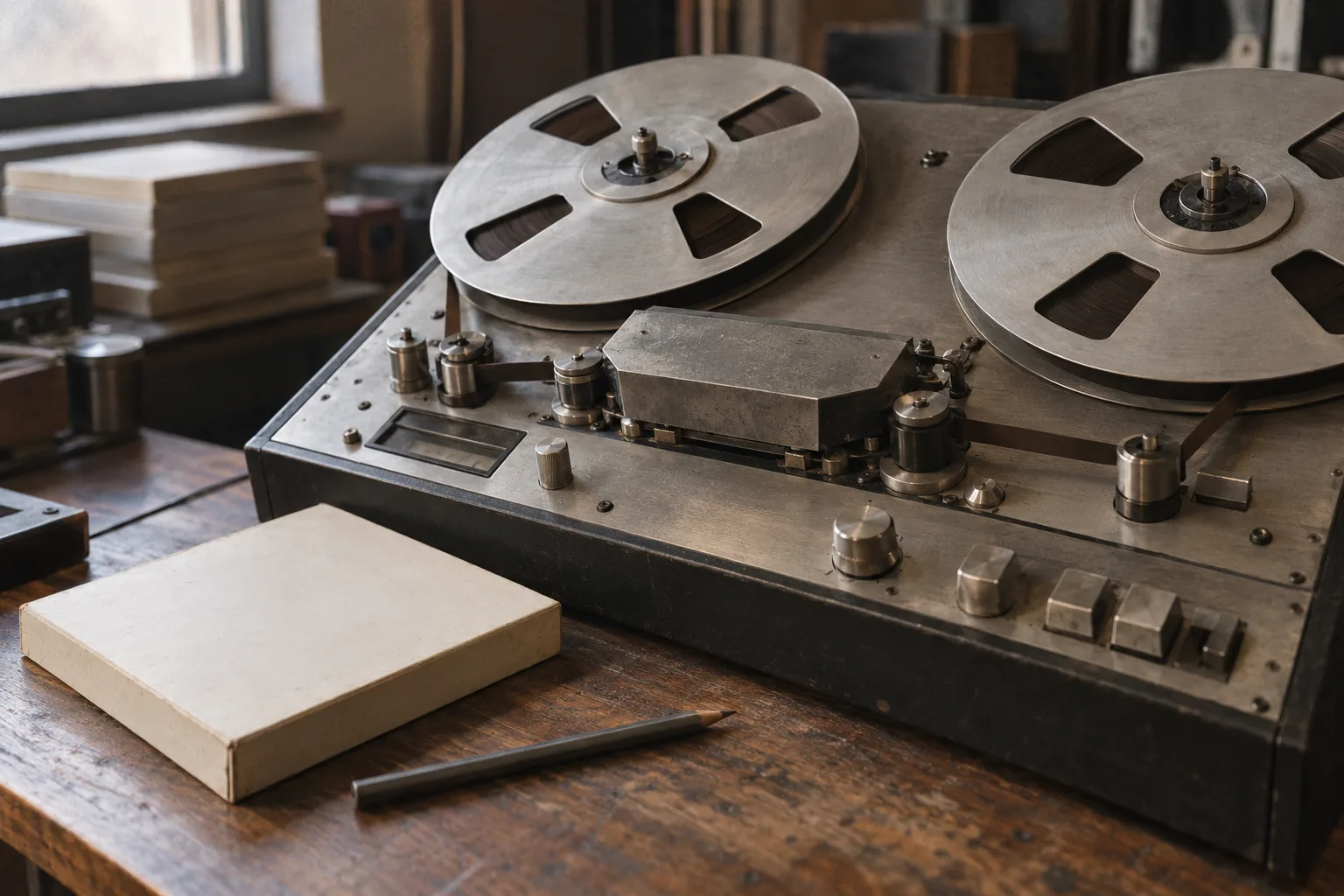
The room is only part of the story
A photograph of an analog console can suggest a whole recording era, but it cannot tell us how a particular album was made. A studio contains tools and possible workflows. Musicians, engineers and producers choose how to use them, and those choices vary from project to project. The equipment is a setting for work rather than a complete explanation of the result.
Olsen's career crosses decades of changing recording practice. This article separates general technical background from documented examples. The historical case we use most closely is his Tape Op interview about mixing Emitt Rhodes' recordings. It offers a direct account of practical problems. The broader explanations describe recording concepts without assigning every procedure or piece of equipment to Olsen.
Multitrack recording in ordinary language
A multitrack recorder stores separate signals so that parts can be balanced later. Separation does not mean that every instrument is perfectly isolated. A microphone can pick up sound from neighboring instruments, and several sources may be recorded together on one track. The number of available tracks influences planning, but it does not by itself determine musical quality.
Imagine drums, bass and guitar being recorded as a basic performance. A vocal or another guitar part can be added afterward as an overdub. The final mix combines those recorded elements into the channels used for release. This simplified description helps explain the stages without pretending that every band used the same order.
A take is a particular recorded attempt. An overdub adds a performance to existing material. An edit joins or alters recorded sections. A mix balances and processes the recorded signals. These terms refer to different actions, even when casual writing uses recording to cover all of them.
Tape changes the practical decisions
Magnetic tape is a recording medium with physical and electrical limits. It can introduce noise; it can distort when levels exceed what a system can accommodate; copying recorded material can change its quality. Engineers work with those properties, sometimes avoiding them and sometimes using an audible effect deliberately. Neither distortion nor noise is automatically desirable because the medium is old.
On a machine with limited tracks, combining several parts into fewer tracks can free space for new performances. That process also reduces the ability to change each original part independently afterward. Planning matters because a decision made early may narrow later options. A good arrangement can reduce the need for such compromises, while a more elaborate arrangement can require careful organization.
Digital systems make some operations easier to reverse, but they do not eliminate decisions. A performance still needs to work, and too many competing parts can still obscure a song. The contrast is about the practical environment, not a verdict that one medium always sounds better.
What a mixing console does
A console brings signals into a working system and provides control over their level and routing. Depending on the design, it may offer equalization, sends to effects and monitoring arrangements. Its physical layout can help several people understand where the session's signals are going. It also requires an engineer to maintain an orderly signal path.
Equalization changes the relative level of frequency areas. Compression responds to signal level and can alter dynamic behavior. Reverberation creates or captures a sense of reflected sound. These functions can support clarity, movement or space, but the mere presence of a device does not prove how it was used on a record.
The production article approaches the same subject from the listening side. Here the distinction is practical: a tool provides a range of actions, and a documented session account establishes which action actually occurred. A photograph alone does neither.
A bounded example from Emitt Rhodes
In the Tape Op interview, Olsen describes unwanted hum and distortion in the home-recorded tapes he mixed. He discusses selective filtering and the difficulty of making tonal changes when those changes also expose problems. The account makes technical work concrete without requiring a myth about a flawless vintage signal chain.
Think of filtering as a compromise between removing an unwanted component and preserving a wanted one. If noise occupies an area important to an instrument, aggressive treatment can affect the instrument too. Mixing therefore involves listening and judgment as well as devices. The appropriate result depends on what matters most in the performance.
This case also makes the roles clear. Rhodes wrote and performed his material and recorded it; Olsen's account concerns what happened when that material arrived for mixing. Calling the whole project an Olsen creation would erase the artist's work. A well-defined technical contribution can be substantial without becoming the sole authorship of a record.
The producer and engineer are different roles
The producer often helps guide the project as a musical and organizational whole. The engineer handles recording systems and the translation of performances into recorded signals. One person may perform both jobs, or responsibilities may be distributed among several people. Album credits are important because titles alone do not describe how a specific team divided the work.
An assistant's contribution can include session organization and technical preparation. A mixer may join after the original recording. A mastering engineer works on the final presentation for a release medium. None of these jobs should disappear from the story simply because a producer is the subject of an article.
For Olsen, the overlap of production and engineering is part of the historical interest. It gives readers a reason to look past a single label. The selected credits guide offers a method for recording precise roles rather than treating every appearance of his name as the same task.
Why a fixed album differs from a live performance
An album presents a sequence of chosen recordings. A concert happens in time, with an audience and the possibility of variation. The Grateful Dead's Terrapin Station is useful for discussing that difference because official retrospective writing considers both its studio precision and the later life of its songs onstage.
The studio offers opportunities to repeat, add and balance performances. Those opportunities can support an arrangement that would be impractical in a regular concert. They can also change the sense of interaction a listener expects from a band. The outcome is a musical question, not simply a technical advantage.
Do not compare an album and a concert as though they were attempts at an identical task. Ask what each version lets you hear: structure, instrumental exchange, a particular singer's phrasing or the feeling of continuity. The tools explain possibilities; the performances explain how those possibilities become music.
From stereo to surround and product development
The Cinema Audio Society's memorial identifies Olsen as a surround-music advocate and describes his later product-development work at Mackie. These details extend the career beyond the most familiar rock-album credits. They indicate continuing engagement with how recorded music is made and presented.
Stereo uses two playback channels. Surround formats use additional channels to organize a listening field around the listener. A surround mix is not simply a louder stereo mix, and a later surround release does not automatically identify the original album producer as its mixer. Credits still need to be checked for the edition and format under discussion.
Product development is another distinct kind of work. It concerns the tools that other people may use to record and mix. A career can include both music production and technology leadership without making every product a musical credit. Keeping these categories separate helps readers understand the breadth of the work accurately.
A modern studio lesson without a gear prescription
Start with the source, define the task and listen to the result. If a microphone captures too much room, consider the performance position and recording space before searching for a complicated repair. If a chorus feels crowded, question the parts before applying processing to every track. These are general working principles, not quotations or formulas attributed to Olsen.
The recording era is valuable because it makes constraints visible. Limited tracks, noisy source material and less reversible operations demanded planning. Today's systems offer other possibilities, but planning still helps musicians spend their attention on music. Historical tools can inspire curiosity without becoming a shopping list or a promise of the same sound.
Sources and scope
These references support the named historical examples. Listening prompts and general studio explanations are editorial context, not claims of firsthand session access. Consult original release booklets for exact track and edition credits.